
🔬 Silicone vs. Isoprene: The Science Behind Drug Stability
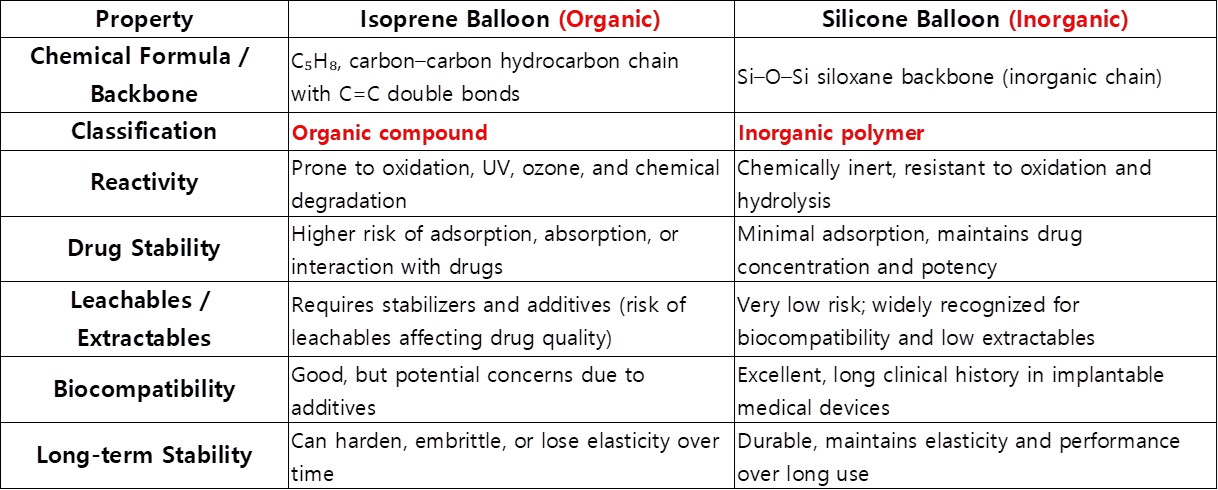
🔬 Silicone vs. Isoprene: The Science Behind Drug Stability
■ Isoprene: Organic (Hydrocarbon-Based)
-
Chemical Formula: C₅H₈
-
A hydrocarbon molecule composed only of carbon (C) and hydrogen (H).
-
Classified as a typical organic compound.
-
When polymerized, isoprene becomes polyisoprene (similar in structure to natural rubber), which is used in medical devices as an organic elastomer.
■ Silicone: Inorganic Backbone (Si–O–Si Bond Based)
-
Backbone: Si–O–Si bonds (siloxane bonds).
-
This silicon–oxygen backbone gives it inorganic characteristics, forming a chain structure distinct from carbon-based compounds.
-
Although side groups such as methyl (–CH₃) are attached and can modify properties, silicone remains fundamentally an inorganic polymer.
📌 Conclusion
-
Isoprene = Organic (hydrocarbon-based)
-
Silicone = Inorganic backbone (Si–O–Si bond based)
✅ Therefore, the reasoning is scientifically valid:
Silicone balloons are inorganic, chemically stable, and superior in drug stability, whereas isoprene balloons are organic and comparatively less stable.
📞 Telephone: +82 10 6335 2697
✉️ Email: jo@ssmed.kr
🏢 Address: 67 Bongseong-ro, Gunpo-si, Gyeonggi-do, 15848, Republic of Korea