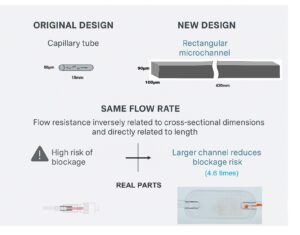
💉 Why Do We Need Microchannels for Chemotherapy Drug Delivery?
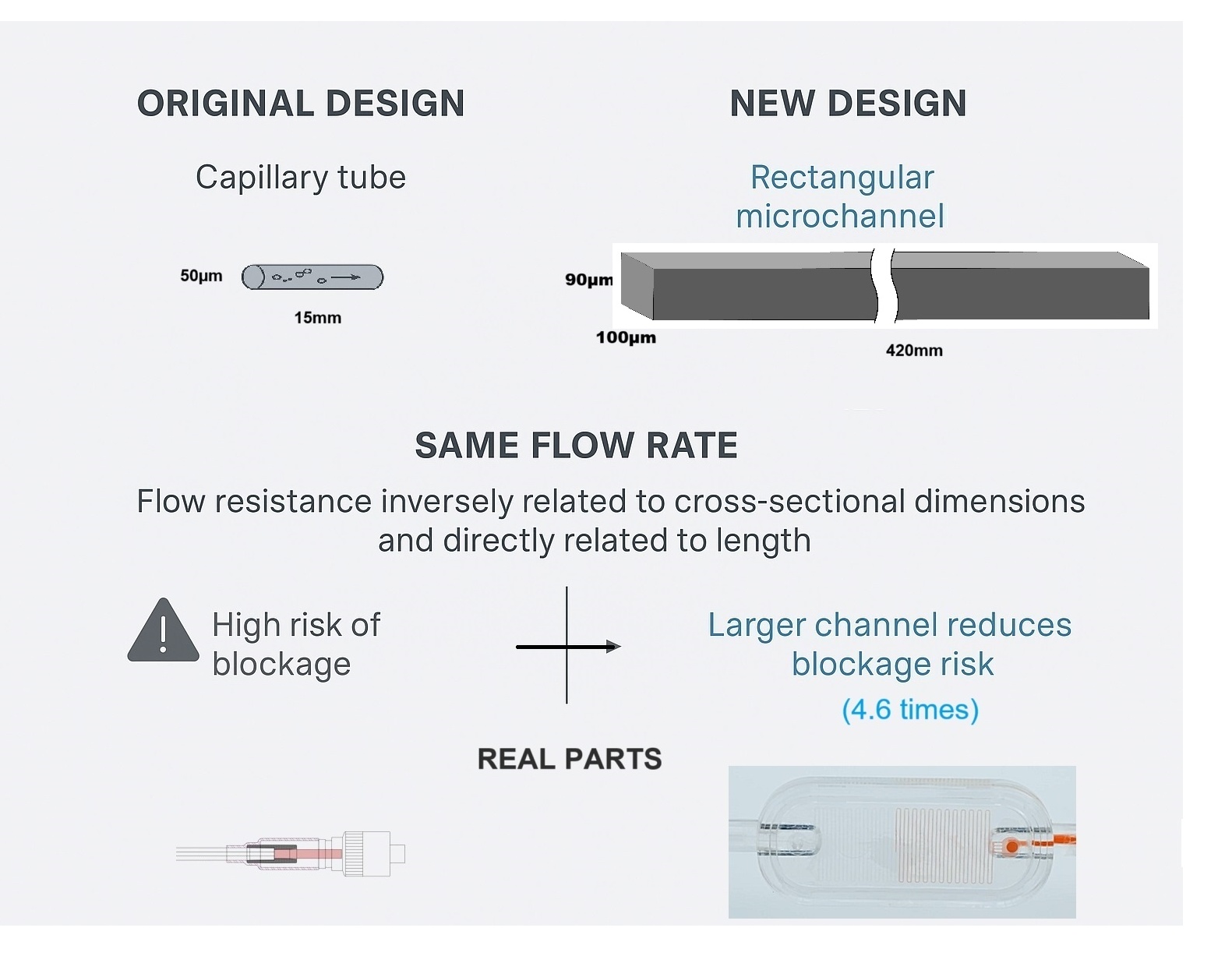
In elastomeric infusion pumps, flow rate is typically controlled using a capillary—a very small tube with an internal diameter of approximately 50 µm and a length of about 15 mm. However, this design is prone to frequent blockage by medication particles.
To address this issue, we developed a microchannel with a larger cross-sectional area—90 µm × 100 µm. Since the cross-section is wider, achieving the same flow rate required increasing the channel length to 420 mm.
- Original design:
- Restrictor type: Capillary tube
- Diameter: 50 µm (circular cross-section)
- Length: 15 mm
- Problem: High risk of blockage due to small diameter
- Your new design:
- Restrictor type: Rectangular Microchannel
- Cross-section: 90 µm × 100 µm (4.6 times larger cross-sectional area)
- Length: 420 mm (28 times longer to maintain same flow rate despite larger area)
- Benefit: Larger channel reduces blockage risk
This makes sense from a fluid dynamics standpoint. For laminar flow in small channels, the flow resistance is inversely related to cross-sectional dimensions and directly related to length. By increasing the cross-sectional area, you decrease resistance—so to keep the same flow rate, you need to compensate with more length.